


Blog - 25/05/2026
How much does a Home Elevator cost?
If you’re planning a home elevator, the first question is simple: how much should you budget? In India, the answer depends on the lift technology, number of floors, cabin size, site condition, and design finish. A lift is not just another home product. It becomes part of daily life, so the right choice should balance cost, safety, comfort, and long-term service.
TL;DR
Home elevator cost in India usually ranges from ₹18 lakh to ₹45 lakh. The final price depends on lift technology, number of floors, cabin size, finish choices, civil work, and site conditions. For premium screw-driven home elevators, the cost is commonly ₹25 lakh to ₹45 lakh, depending on layout and customization.
What is the average home elevator cost in India?
In most Indian homes, a residential elevator costs anywhere between ₹18 lakh and ₹45 lakh. This is a planning range, not a fixed quotation. A final price needs a site check because every home has different floor levels, space conditions, electrical readiness, and design expectations.
Average home elevator cost by technology
| Elevator Type | Approximate Price Range | Main Cost Driver |
|---|---|---|
| Hydraulic Elevator | ₹8 to ₹28 lakh | Pit, machinery, oil system, cabin size, and number of floors |
| Traction or MRL Elevator | ₹16 to ₹28 lakh | Motor, shaft planning, ropes, counterweight system, and site structure |
| Pneumatic or Vacuum Lift | ₹14 to ₹30 lakh | Cylinder size, travel height, model capacity, and import or installation scope |
| Screw-Driven Home Elevator | ₹25 to ₹45 lakh | Drive system, finish quality, glass or cabin design, compact planning, and customization |
These are indicative figures, but they reflect what most homeowners actually spend today.
Why do home elevator prices vary so much?
Home elevator pricing changes because the project is shaped by the home, not only by the lift. A G+1 home, duplex, villa, and luxury residence can all need different layouts and finish levels.
| Cost Factor | How It Affects Price | What to Confirm During Site Survey |
|---|---|---|
| Number of Floors | More stops usually increase travel height, material requirement, and installation scope. | Confirm number of stops and clear travel height. |
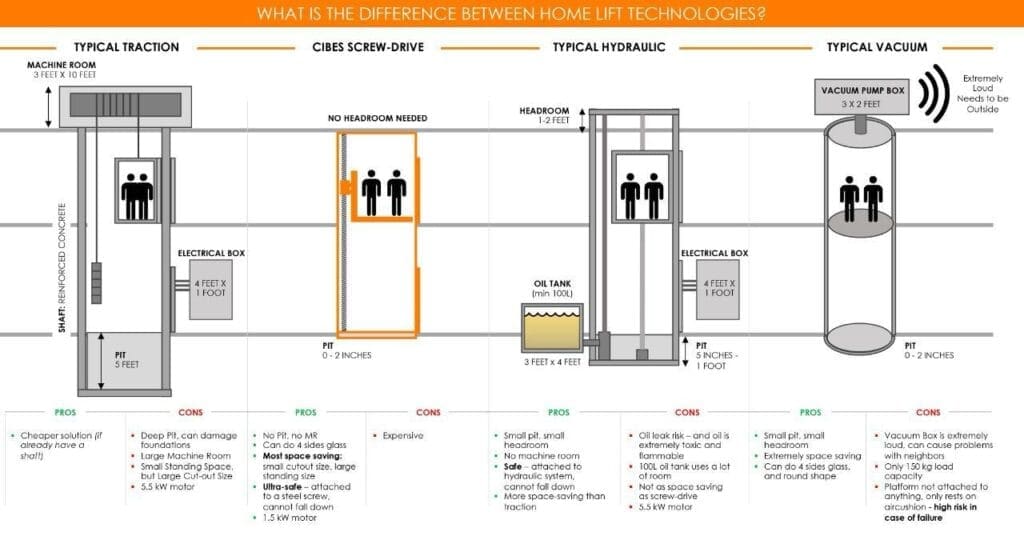
| Lift Technology | Hydraulic, traction, vacuum, and screw-driven systems use different mechanical layouts. | Confirm technology fit for the home structure. |
| Civil Work | Deep pits, machine rooms, larger shafts, or structural changes can raise total project cost. | Confirm pit, headroom, shaft, and floor opening needs. |
| Cabin Size and Design | Larger cabins, glass walls, lighting, and premium finishes affect the final price. | Confirm cabin size, entry side, finish, and door type. |
| Customization | Special colors, panels, automatic doors, and design upgrades add to the quote. | Confirm must-have and nice-to-have upgrades separately. |
Why do many homeowners compare screw-driven home elevators?
A screw-driven elevator travels along a strong steel screw to move the platform or cabin between floors. The lift stays connected to the drive system through the journey, which helps create controlled movement in daily use.
A screw-driven lift should still be selected after checking travel height, floor levels, load requirement, available space, and site readiness. That is why a site survey matters before finalizing the model or budget.
| What It Means | Practical Benefit for the Home |
|---|---|
| No ropes or hydraulic oil | Maintenance planning can be simpler compared with systems that depend on ropes or oil. |
| Compact drive layout | The lift can often be planned beside stairs, in corners, or in compact areas. |
| No separate machine room | This can simplify planning in many Indian homes, depending on model and site condition. |
| Controlled travel | The ride can feel smooth and steady when installed and maintained correctly. |
Why does installation matter in Indian homes?
Many Indian homeowners think about a lift after the home is already built. In that case, the cost of civil work, site preparation, and space changes can matter as much as the lift price.
| Installation Factor | Why It Matters | Condition to Verify |
|---|---|---|
| Fewer structural changes | Can reduce disruption in existing homes. | Check floor opening, wall support, and layout. |
| Self-supporting structure | May reduce the need for a separate concrete shaft in many projects. | Confirm model and structural requirement. |
| Limited pit requirement | Some Cibes models can work with 0 mm or up to 100 mm pit options, depending on configuration. | Confirm exact model and site floor level. |
| Compact footprint | Useful in corners, stairwell areas, or planned interior spaces. | Confirm clear platform size and landing space. |
| Electrical load | The page states around 2.7 to 3 KW during operation. | Technical team must verify for selected model. |
How should you look beyond the purchase price?
A home elevator is a long-term part of the house. The better comparison is not only the buying cost, but the total ownership experience: civil work, service access, maintenance tasks, design life, and everyday comfort.
| Aspect | Screw-Driven | Hydraulic | Traction |
|---|---|---|---|
| Oil replacement | No | Yes | No |
| Rope replacement | No | No | Yes |
| Maintenance complexity | Low | Medium | High |
| Chance of unplanned service pause | Very low | Medium | Medium |
Maintenance experience depends on product model, installation quality, service schedule, and site conditions.
Is a Cibes screw-driven home elevator worth the higher price?
For many premium homes, a Cibes screw-driven home elevator may justify the higher upfront price when the homeowner values compact planning, lower civil work, premium finish options, and a clean fit inside the home. The final decision should still come from the site layout, selected model, finish level, number of stops, and service expectations.
| Cibes Proof Point | How to Present It Safely |
|---|---|
| Factory-direct engineering | Mention better control over design, production quality, and finished lift consistency. |
| Screw-driven technology | Explain the controlled movement clearly without absolute safety claims. |
| Glass specification | Place 8.76 mm toughened laminated glass and cited standards in a technical note after internal verification. |
| Compact installation | Tie the claim to model and site condition. |
Typical home elevator costs by home type
| Home Type | Expected Price Range | Planning Note |
|---|---|---|
| G+1 independent house | ₹18 to ₹23 lakh | Usually lower cost because travel height and number of stops are limited. |
| G+2 or duplex home | ₹25 to ₹35 lakh | Cost rises with travel height, stops, and installation scope. |
| Luxury customized home | ₹35 to ₹45+ lakh | Premium finishes, glass, automation, and customization can increase the budget. |
Which home elevator budget should you plan for?
If the home is already built, do not compare only the lift price. Compare the complete project cost, including civil work, shaft or structure requirement, electrical readiness, number of stops, cabin finish, and after-sales maintenance. A lower initial quote can become less practical if the lift needs more construction or frequent service planning.
Frequently Asked Questions About Home Elevator Cost in India
What is the average home elevator cost in India?
In most Indian homes, a residential elevator usually costs between ₹18 lakh and ₹45 lakh. The final price depends on technology, number of stops, cabin size, customization, and site conditions.
Why do home elevator prices vary so much?
Prices vary because each home has different floor levels, available space, structural conditions, cabin requirements, and finish choices.
Does lift technology affect the price?
Yes. Hydraulic, traction, vacuum, and screw-driven lifts have different installation needs, mechanical systems, maintenance tasks, and space requirements.
Is civil work always needed for a home lift?
Some site work is usually needed, but the amount depends on the lift technology and installation plan. Screw-driven lifts often need less civil work than systems that require deeper pits or machine rooms.
Does a screw-driven home elevator cost more upfront?
It can cost more upfront than some basic systems, but the total value depends on civil work, long-term maintenance, design fit, and everyday use.
What is included in a home elevator quote?
A proper quote should clarify the lift model, number of stops, cabin size, finishes, doors, civil work scope, electrical requirement, installation, warranty, and service terms.
About the author
Atul Shekhar
India Marketing Head, Cibes Lift India
Atul Shekhar is the Head of Marketing India at Cibes Lift India, with professional experience across GTM, brand marketing, performance marketing, trade marketing, and AI-led growth. His work focuses on helping Indian homeowners, architects, builders, and design professionals understand premium home lifts, compact lift planning, and modern residential mobility solutions. Atul brings a practical marketing perspective to the home elevator industry, shaped by his work at Cibes Lift India and earlier professional roles listed on LinkedIn. He writes about home lift design, space planning, customer education, and technology-led residential mobility with a clear, reader-first approach.



Before installing a home elevator, ask the questions that really matter.
Space, safety, cost, installation, service, warranty, and design all play a role in choosing the right lift for your home.
Read the full blog by Cibes Lift India.

A screw-driven home lift works through a simple mechanical principle: a motor-driven nut travels along a fixed vertical screw shaft. The platform is attached to this nut, so as the motor turns, the lift moves up or down in a controlled path. When the motor stops, the platform stays in place on the shaft. If power goes out, the system’s response depends on whether your lift includes battery backup or emergency lowering support.

A home elevator can change the way a multi-level home feels every day. It makes movement between floors easier, helps with carrying daily essentials, adds comfort for the whole family, and brings a refined design touch to modern Indian homes.
In this blog, we explain 5 key advantages of adding a home elevator, from safety and convenience to long-term value and lifestyle comfort.

Planning a home elevator but not sure about the cost?
This guide explains the main factors that shape home elevator pricing in India, including technology, number of floors, site conditions, civil work, cabin size, and design choices.
Because the right lift is not always about the lowest price. It’s about safety, comfort, fit, and long-term ease.
Read the full blog by Cibes Lift India.

Choosing the right home lift starts with understanding the technology behind it. Our latest guide compares lift technologies for Indian homes in 2026, from space and safety to comfort and civil work. Read the technical comparison and see which option fits your home best. Request brochure and layout options today.

We offer lifts for any application, and regardless if you need a lift for your home, a school, an office, a hotel or a warehouse, we have the perfect lift model for you,a hotel or a warehouse, we have the perfect lift model for youa hotel or a warehouse, we have the perfect lift model for you
See all


